Gesamt- und Einzelbewertung der Nordseeküstengewässer Deutschlands gemäß Wasserrahmenrichtlinie. Es werden Qualitätskomponenten Phytoplankton (QE1_1), Großalgen und Angiospermen (QE1_2) und Makroinvertebraten (QE1_3) sowie der ökologische und chemische Gesamtzustand der Küstengewässer bis zur Hoheitsgrenze dargestellt.
Gesamt- und Einzelbewertung der Nordseeküstengewässer Deutschlands gemäß Wasserrahmenrichtlinie. Es werden Qualitätskomponenten Phytoplankton (QE1_1), Großalgen und Angiospermen (QE1_2) und Makroinvertebraten (QE1_3) sowie der ökologische und chemische Gesamtzustand der Küstengewässer bis zur Hoheitsgrenze auf dem 10x10 km Grid der Europäischen Umweltagentur dargestellt. >50%-Ansatz: Rasterzellen die ganz oder auch nur zum Teil Meeresgewässer beinhalten, bekommen den Wert, der von mehr als 50% der entsprechenden Meeresfläche des zu bewertenden Attributes eingenommen wird.
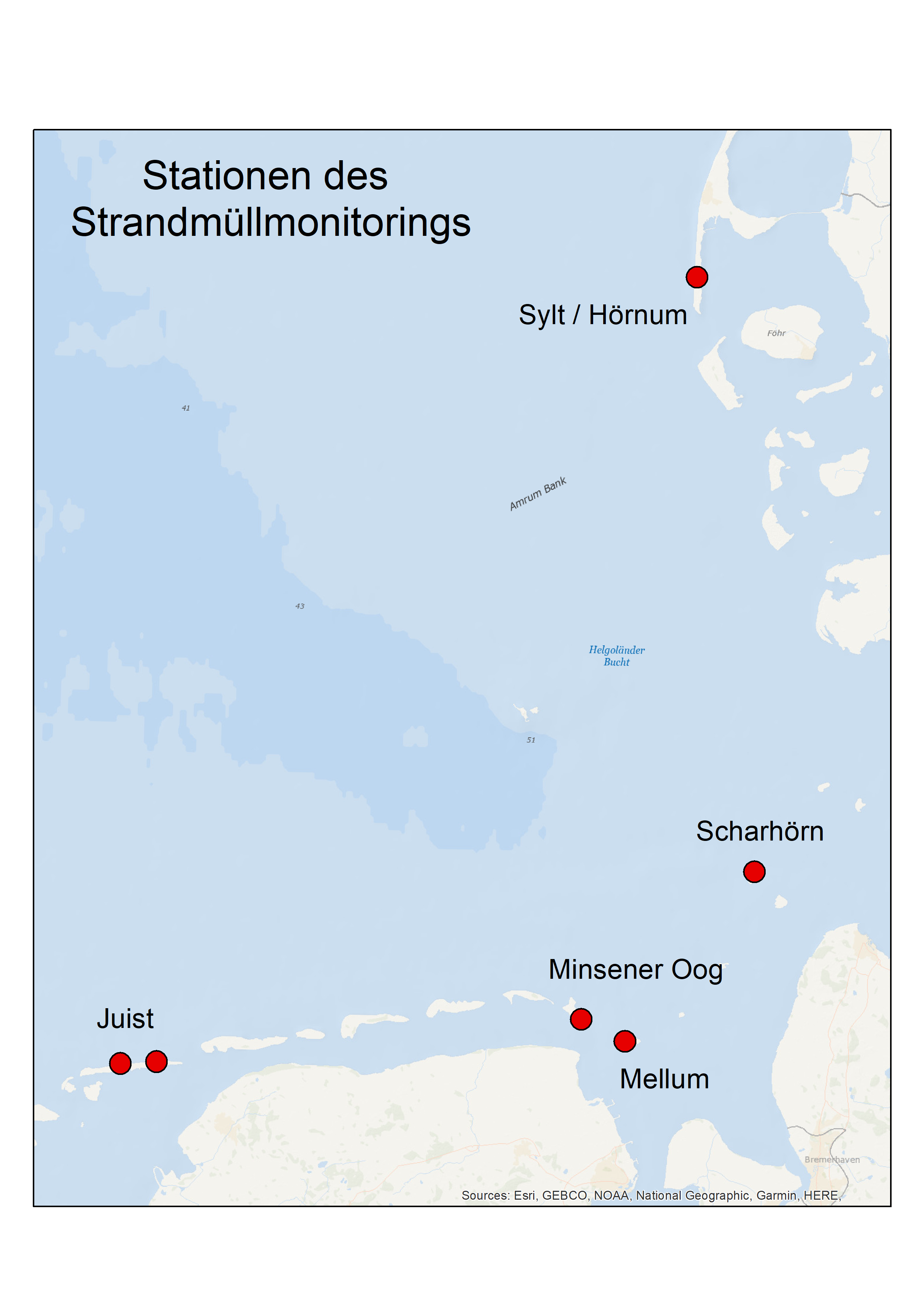
Download-Dienst der zusammengeführte Daten des Strandmüllmonitorings der schleswig-holsteinischen, hamburgischen und niedersächsischen Nordseeküste. Das Strandmüllmonitoring erfolgt nach der OSPAR Beach Litter Guideline (2010). Es werden dabei bei bis zu 4 Erfassungen pro Monitoringjahr alle Müllteile auf vorgegebenen 100m-Transekten erfasst. Ein Monitoringjahr umfasst alle Erfassungen von Anfang Dezember des vorhergehenden Jahres bis Ende November des genannten Jahres. Bei den hier bereitgestellten Daten handelt es sich sowohl um die geprüfte Rohdaten (Layer:Strandmüllmonitoring (MDI_MM_BL_WFS) als auch um aggregierte Daten: Mittlere Anzahl Müllteile 2012-2017 (BL_ges_1217), Mittlere Anzahl Müllteile 2018 (BL_ges_2018), Mittlerer Anteil Plastik 2012-2017 (BL_Pla_1217), Median Müllteile 2012-2017 (BL_MED_ges_1217). Weitere Informationen: https://www.ospar.org/work-areas/eiha/marine-litter/assessment-of-marine-litter
TMAP parameter group: Contaminants in flounder (in CD). Gemeinsames Bund/Länder-Messprogramm für die Nordsee The trilateral Monitoring and Assessment Program was established in 1994 and contains 28 chemical, biological, geological and common parameter. Analyses enable an assessment on the trilateral agreed ecological targets. Results are published as Quality status report regularly. Investigations are done with regard to the following issues of concern primarily (Kellermann, A. et al. 1994): - Effects of climate change on the morphology, - Effects of pollutant inputs (nutrients and contaminants) on processes, species and communities, - Effects of fisheries on species and communities, - Effects of recreational activities on species, - Effects of agricultural utilization on salt marsh communities.
TMAP parameter group: Contaminants in flounder (in CD). Gemeinsames Bund/Länder-Messprogramm für die Nordsee The trilateral Monitoring and Assessment Program was established in 1994 and contains 28 chemical, biological, geological and common parameter. Analyses enable an assessment on the trilateral agreed ecological targets. Results are published as Quality status report regularly. Investigations are done with regard to the following issues of concern primarily (Kellermann, A. et al. 1994): - Effects of climate change on the morphology, - Effects of pollutant inputs (nutrients and contaminants) on processes, species and communities, - Effects of fisheries on species and communities, - Effects of recreational activities on species, - Effects of agricultural utilization on salt marsh communities.
TMAP parameter group: Contaminants in flounder (in CD). Gemeinsames Bund/Länder-Messprogramm für die Nordsee The trilateral Monitoring and Assessment Program was established in 1994 and contains 28 chemical, biological, geological and common parameter. Analyses enable an assessment on the trilateral agreed ecological targets. Results are published as Quality status report regularly. Investigations are done with regard to the following issues of concern primarily (Kellermann, A. et al. 1994): - Effects of climate change on the morphology, - Effects of pollutant inputs (nutrients and contaminants) on processes, species and communities, - Effects of fisheries on species and communities, - Effects of recreational activities on species, - Effects of agricultural utilization on salt marsh communities.
TMAP parameter group: Contaminants in flounder (in CD). Gemeinsames Bund/Länder-Messprogramm für die Nordsee The trilateral Monitoring and Assessment Program was established in 1994 and contains 28 chemical, biological, geological and common parameter. Analyses enable an assessment on the trilateral agreed ecological targets. Results are published as Quality status report regularly. Investigations are done with regard to the following issues of concern primarily (Kellermann, A. et al. 1994): - Effects of climate change on the morphology, - Effects of pollutant inputs (nutrients and contaminants) on processes, species and communities, - Effects of fisheries on species and communities, - Effects of recreational activities on species, - Effects of agricultural utilization on salt marsh communities.